
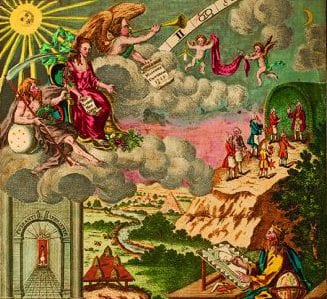
Femininity has always been present within the temple. Freemasonry has relied for centuries on the female relatives of members and on auxiliary groups of women to help lodges raise funds, prepare for special events, sew regalia, and assist members with learning rituals at home. Even Masonic ritual includes virtues and lessons symbolized by women. The images included here demonstrate some of the ways that femininity is threaded into Masonic ritual and lessons.
Faith, Hope and Charity
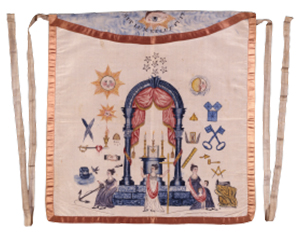
Faith, Hope, and Charity are among the most common Masonic symbols seen on aprons, charts, tracing boards, and other Masonic props and engravings. Known as theological virtues, and almost exclusively portrayed as women, they are introduced in Freemasonry’s Entered Apprentice degree.
Keeping Within the Compass
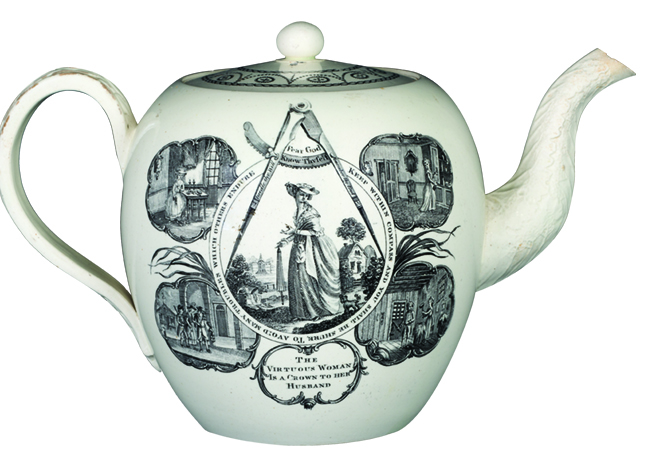
Keeping within Compass was a popular cultural tenet in England and in America during the 1700s, both inside the lodge and outside. A message of self-control, this stricture was widely understood throughout society. Freemasons adopted the idea during the mid- and late-1700s. This teapot, made in the 1790s in Yorkshire, England, uses non-Masonic images of a man and a woman “keeping within compass” and demonstrates the impact that Freemasonry had on both sexes when a man was an active member.
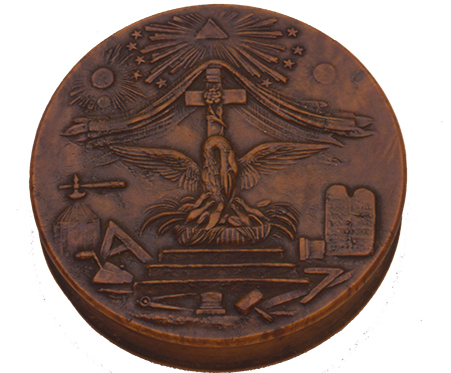
Pelican Pricking Her Breast to Feed Chicks
Pelican Pricking Her Breast to Feed Chicks, one of the central symbols for the Scottish Rite’s Rose Croix degree, symbolizes maternal love and sustenance. The pelican is also a symbol of resurrection.
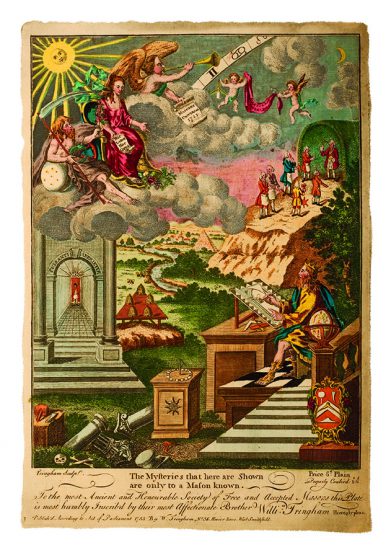
Aurora, Goddess of the Dawn
Aurora, Goddess of the Dawn is not as commonly seen in Masonic ritual as some of the other symbols shown here. This 1755 engraving by William Tringham (1723-1770?), “The Mysteries that Here are Shown, Are Only To a Mason Known” could have been used to decorate the lodge or a member’s home. Associated with light and bringing the dawn, it is no wonder that she appears on a Masonic print that celebrates the fraternity’s chief purpose of seeking enlightenment.
Time and the Virgin
Time and the Virgin teaches Masons that “time, patience, and perseverance will enable [them] to accomplish the great object of a Mason’s labor.” The symbol signifies the passage of time and mourning; the virgin grieves for the unfinished state of the temple. It is often credited to Jeremy Cross, author of The True Masonic Chart, or Hieroglyphic Monitor. Mendocino Lodge No. 179 is known for its sculpture of this symbol, carved out of a solid block of redwood by the lodge’s first master, Erick Albertson, between 1865 and 1872.
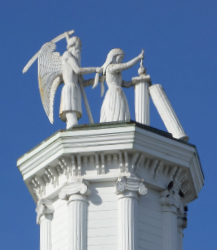
PHOTO CREDIT: David Bohl, John M. Miller, Collection of the Scottish Rite Masonic Museum & Library.