2026 International Conference on Freemasonry
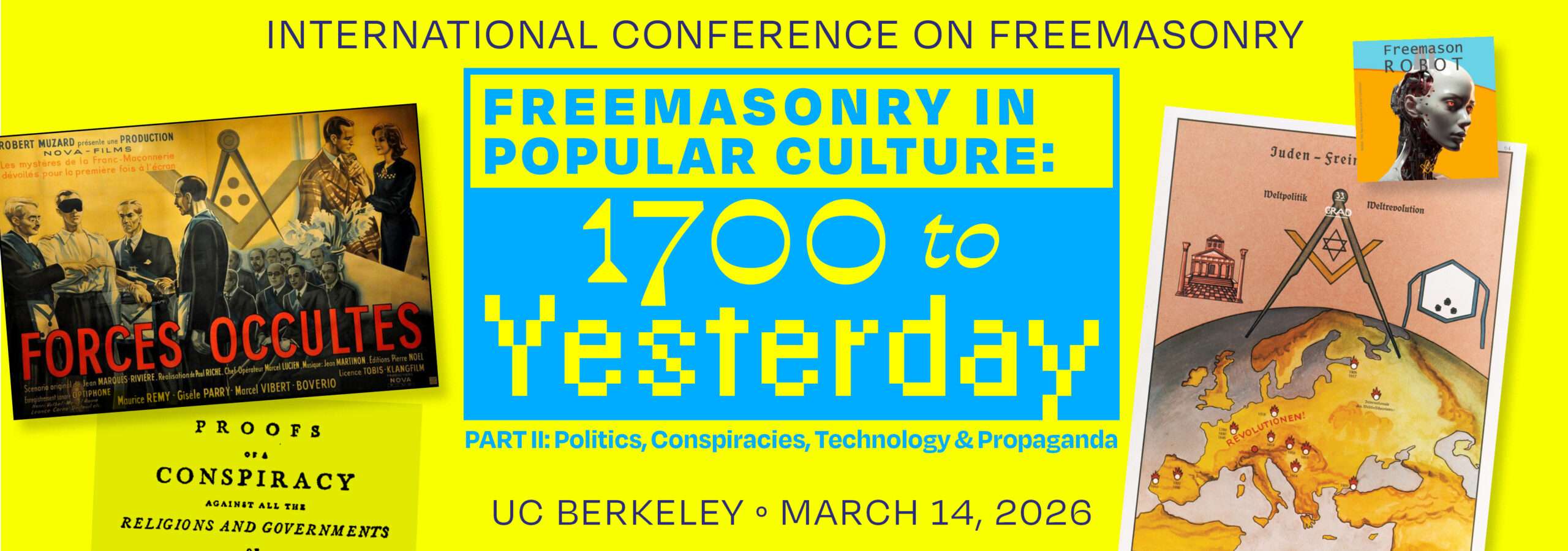
“Freemasonry in Popular Culture: 1700 to Yesterday”
Part II: Politics, Conspiracies, Technology and Propaganda
Saturday, March 14 at the University of California, Berkeley, Clark Kerr Auditorium
Admission: $50; optional lunch $22
Join with Masons and scholars from around the world at the 2026 International Conference on Freemasonry on March 14, 2026 as we dive into the fraternity’s relationship to film, politics, and propaganda.
From Nazi-era signage to Illuminati scares, this year’s conference is going deep on supposed Masonic plots throughout history—and the cultural ephemera associated with exposing them.
Register today to secure your spot at this can’t-miss Masonic education event, being held March 14 at UC Berkeley’s Krutch Theatre at Clark Kerr Campus.

Speakers
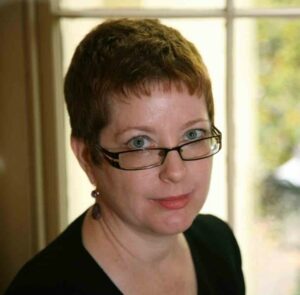
Dr. Susan Mitchell Sommers
Chair of the International Conference of Freemasonry
St. Vincent College, Pennsylvania
“Father Noah and the Royal Ark Masons”
In 1790, eccentric astrologer‑physician named Ebenezer Sibly—better known as “Father Noah”—quietly engineered one of the most audacious political stunts in British history. With no political experience, Sibly built a faux Masonic lodge from scratch, initiated local freemen, and then mobilized them to deliver a parliamentary seat to his employer, Sir John Hadley D’Oyly.
This session revisits the strange alliance between Sibly and influential Freemason Thomas Dunckerley, reexamining how their connections blurred the lines between genuine Masonic orders and Sibly’s fabricated Royal Ark Masons.
Speaker bio: After earning a Ph.D in British history at Washington University, Susan Mitchell Sommers joined the faculty at Saint Vincent College in Latrobe, Penn., where she is a professor of history. Sommers has been a fellow of the Royal Historical Society since 2014 and has been involved in editing the Journal for Research into Freemasonry and Fraternalism as well as Zeitschrift für Internationale Freimaurer-Forschung.
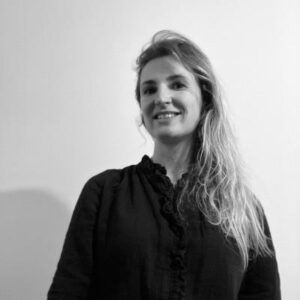
Amanda Brown-Peroy
Professor of English at the University of Bordeaux
“The Judeo-Masonic Conspiracy and the Use of Propaganda in the WWII Period: Film, Radio, Pamphlet, and Exhibition”
Presentation Abstract: The Judeo-Masonic conspiracy is a well-known theory associating Jews and Freemasons in their supposed alliance to achieve world domination. Although this alleged scheme still circulates today among certain conspiracy circles, the turn of the 20th century and the years leading up to the Second World War constitute its heyday. In this paper, we’ll explore the alleged links between the Jewish community and Freemasonry, and the use of this association by Nazi Germany through a multi-faceted propaganda targeting the civil populations of the invaded and enemy countries of the Reich.
Speaker Bio: Dr. Brown-Peroy is a professor of English at the University of Bordeaux. She completed her Ph.D in English Studies in 2016. Her doctoral thesis was titled: “Freemasonry and the Notion of Secrecy in 20th Century England: From World War II to the 2000s.” Brown-Peroy has published numerous academic articles dealing with aspects of 20th century English Freemasonry. Her many presentations include one at the 2014 meeting of this conference, titled “Secrecy as a Universal Factor of Both Inclusion and Exclusion.”
Dr. Felipe Côrte Real de Camargo
Ph.D candidate, Department of History, Iowa State University
“Masonic Secrets on the Silver Screen: Representations of the Craft in the Seventh Art”
Presentation Abstract: Since its invention, cinema has become one of the most powerful and popular tools for transmitting ideas and shaping ideologies. Although modern Freemasonry was already nearly two centuries old when the Lumière brothers held their first public screening, it was through cinema that many people first encountered an image—often inaccurate—of what Freemasonry was. These portrayals, while rarely faithful, fueled the popular imagination and helped embed Freemasonry into 20th-century pop culture. This paper explores how Freemasonry has been represented in film across different countries and genres, examining the purposes these portrayals served in their specific historical and political contexts.
Speaker Bio: Felipe Côrte Real de Camargo is a historian at the University of Bristol, where he obtained a Ph.D in historical studies. His research focuses on the material culture of Freemasonry, secrecy, moral philosophy, and emblematic traditions in the 18th century. He has taught at both Cardiff and Bristol universities, contributed to international journals, and presented his work at major conferences across Europe and the Americas.
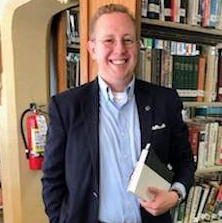
Erich Morgan Huhn
Ph.D candidate in History & Culture at Drew University, New Jersey
“Illuminati, Illuminism, Illuminatus: The Making of Modern Conspiracy”
Presentation Abstract: As conspiracy theories become increasingly mainstream, what can we learn from two classic conspiracy tales? In 1797 John Robison published “Proofs of a Conspiracy” and set off Illuminism, a frenzy of conspiracy thinking. In 1975, Robert Shea and Robert Anton Wilson published The Illuminatus! Trilogy, which revived popular culture’s obsession with the Illuminati. Although these two publications were separated by over 175 years, the impact they had on spurring conspiracy theories were similar.
Speaker Bio: Erich Morgan Huhn’s research focuses on the way Freemasonry and fraternal organizations helped reinforce middle-class values and were used as tools of social “placing” throughout the long 19th century. In 2019, he published New Jersey’s Masonic Lodges (Arcadia Publishing), which examined the way the fraternity used architecture to connect with the organization’s foundation myth and present an air of authority and legitimacy. He has contributed reviews, chapters, and entries to several Masonic and academic works.
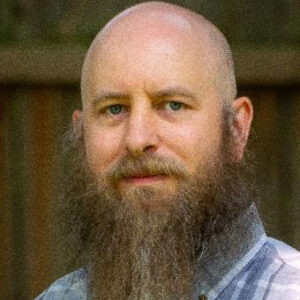
Timothy Sheils
Informatics scientist and software developer
“Magic Lantern Slides—an Early Masonic Adoption of Technology”
Presentation Abstract: Magic lanterns represent one of the first steps away from the traditional tracing board or master’s carpet. Initially powered by candles or kerosene lanterns, a glass slide was inserted into a slot and projected through a lens onto an opposing surface. These slides were manually changed during the various lectures, allowing emphasis on different symbols. Through the late 1800 to mid-1900s, various manufacturers of both lanterns and slides produced materials for Masonic lodges, among other organizations, and eventually contributed to the standardization of the presentation of Masonic symbolism. These slides were used throughout Masonic degrees, at no small cost to the lodges.
Speaker bio: Timothy Sheils works with the National Center for Advancing Translational Sciences, where he serves as an informatics scientist and software developer. He has published a number of papers on the intersection of chemistry and pharmaceuticals with new technologies. He has a special interest in developing therapies for rare diseases. Sheils has degrees in philosophy and sociology and computer science.